There is a letter that arrives at small businesses in America, and it is one of the most misunderstood pieces of mail in commerce. It is from an organisation you have probably heard of and almost certainly cannot describe. It says you owe money for music. It is usually correct.
The reason it feels like a scam is that nobody explains the machinery behind it. So here is the machinery.
What a performing rights organisation actually does
When a songwriter writes a song, they own the exclusive right to perform it publicly. That right is worth something, but it is almost impossible to collect on individually — no songwriter can police every café in America, and no café could find every songwriter.
So writers assign that collection to an intermediary. The intermediary signs up tens of thousands of writers, offers businesses a single blanket licence covering the whole repertoire, collects the fee, and distributes it to writers based on performance data. That intermediary is a performing rights organisation, or PRO.
It is, genuinely, an elegant solution to an impossible coordination problem. It is also why the letter is confusing: the organisation writing to you has no relationship with you, represents people you have never met, and is asking for money on their behalf. That is not a scam. That is the design.
The five that license US businesses
Most articles say there are three. Some say four. There are five.
ASCAP — the American Society of Composers, Authors and Publishers. Founded 1914, structured as a membership association owned by its writers and publishers.
BMI — Broadcast Music, Inc. Founded 1939 by broadcasters who wanted an alternative to ASCAP. Historically non-profit; acquired by the private-equity firm New Mountain Capital in a deal that closed on 8 February 2024, and converted to a for-profit model. That is a real change to the incentive structure of an organisation that licenses hundreds of thousands of small businesses, and it happened with very little public attention.
SESAC — invitation-only rather than open-membership, and considerably smaller. Majority-owned by Blackstone.
GMR — Global Music Rights. Founded 2013, deliberately tiny and deliberately selective: a few hundred songwriters, but very high-value ones. Because the roster is small, businesses sometimes assume they can skip it. That assumption is only safe if you are certain none of those writers' songs will ever play in your room.
AllTrack — founded 2017, launched 2019, a CISAC member, and the one nearly everybody omits. It sells business licences explicitly, and its own licensing page lists the triggers: audio streaming, TV or video streaming, background music services, live performances, live DJs, karaoke, digital files, CDs or records, jukeboxes.
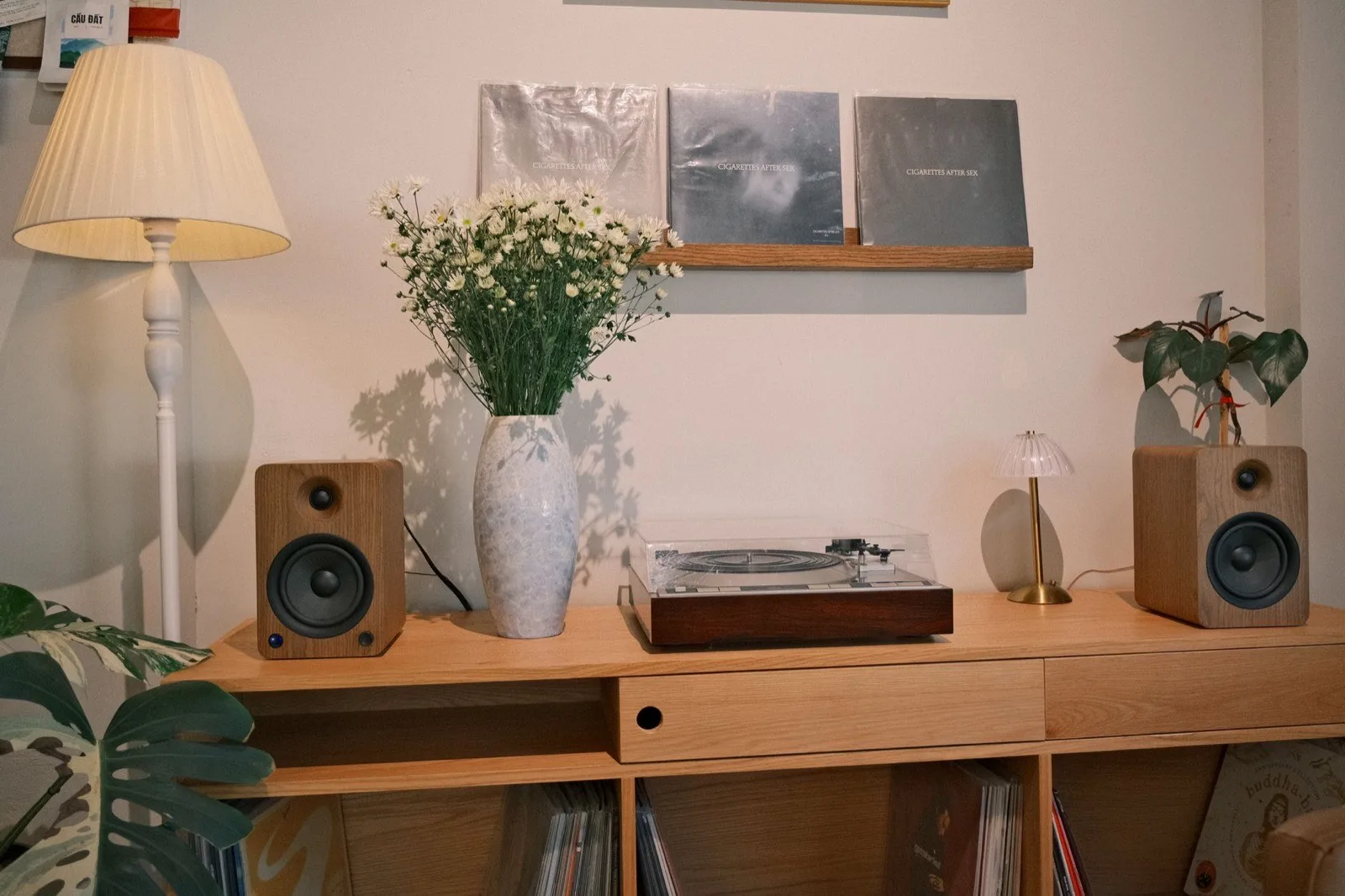
Every song on that shelf may be split across more than one organisation. Photograph: Việt Anh Nguyễn / Pexels.
Why one licence is rarely enough
Here is the part that makes people angry, and it is worth understanding rather than resenting.
Songs are co-written. Constantly. A track with four credited writers may have those writers spread across three different PROs, and each organisation licenses only its own writers’ shares. Hold one licence and play that song, and you have cleared part of it.
This is why the industry standard for a business that wants to play more or less anything is multiple licences. It is not a shakedown; it is a consequence of collaborative songwriting meeting a fragmented collection system. But the practical effect on a café owner is real: you are negotiating with several organisations to solve one problem.
The letter is not a scam. It is a bill from a system you were never told you had joined.
What they cost
Two of the five publish their prices, and the numbers are more specific than most pages suggest. For a restaurant, bar or café playing recorded music, ASCAP's 2026 schedule charges $4.69 per occupant a year with a $502 minimum, and BMI's current rate card charges $4.10 per occupant with a $550 minimum. A venue of up to 107 occupants pays both minimums: $1,052 a year to those two. Shops are priced by speakers (ASCAP) and square footage (BMI) instead.
SESAC, GMR and AllTrack do not publish rate cards; each quotes your venue on request. Be wary of pages quoting BMI at $3.90 and $485: those are from BMI's February 2025 form, since replaced.
The full breakdown, with a calculator that does the arithmetic each rate card asks for, is in how much a music license costs a restaurant.

The moment a musician plugs in, you have left the blanket licence behind. Photograph: Luis Becerra / Pexels.
One route sidesteps the PROs entirely for some businesses, and it is worth knowing before you sign anything: the radio exemption is real, and narrower than it sounds.
What a PRO licence does not cover
A blanket licence covers the musical composition — the song as written. It is worth knowing what sits outside it:
- Live performance of dramatic works — a full musical staged in your venue is a different licence entirely, negotiated directly.
- Sync — putting music behind video you publish is a separate right. Your café’s PRO licence does not let you score your Instagram reel.
- Recording or redistribution — the licence is to perform, not to copy.
There is also a common misconception in the other direction. For music played over your own speakers in your own room, you generally do not owe the record label separately. Sound recordings have a narrower public performance right under US law, limited to digital audio transmission. Your ceiling speakers are not a digital audio transmission. The composition side — the PROs — is the side that applies to you.
The route most businesses never consider
Everything above describes the blanket-licence model, which exists because ordinary catalogues are owned by millions of parties.
A catalogue owned by one party does not have that problem. There is a single rights holder to ask, so the public performance right can simply be granted in the subscription — no letters, no five organisations, no reconciliation. That is what Puana is: original music we own outright, with the commercial performance right included for the locations on your plan.
That is not a claim that PRO licences are bad. If you want to play the actual charts in your venue, a blanket licence is the correct instrument and there is no substitute for it. It is a claim about what problem you are solving. If what you need is good music in your room and no administrative surface area, buying access to a catalogue with one owner is a structurally simpler answer than buying five licences to a catalogue with millions.
The short version
Five organisations license US businesses: ASCAP, BMI, SESAC, GMR, AllTrack. They collect on behalf of songwriters, not record labels. Co-writing across organisations is why one licence rarely covers everything. Pricing is venue-specific and you should get it from the source. And the letter, when it comes, is a bill from a system you were never told you had joined — not a scam, and not something that improves by being ignored.
If you are still working out whether any of this applies to you, start with the full picture: what the law actually says about playing music in your business.
Verified against each organisation’s own published material, July 2026. Nothing here is legal advice; if real money rides on a specific decision, talk to a media or IP attorney.